
Architecting a Predictive SaaS Platform for Uranium Exploration

A leading exploration company approached Empower Solutions to help them transform decades of public-domain geological data – scattered across legacy formats into a unified intelligence layer capable of supporting high-precision uranium targeting.
Uranium exploration is capital-intensive, slow, and critically dependent on data quality.
This project is part of a multi-phase, in-progress initiative to create a global AI-powered SaaS platform for mineral exploration. The current and foundational phase focuses on data extraction and normalization, working directly with these archival datasets.
The effort centered around one of the world’s largest and most heterogeneous geological archives – a multi-decade dataset maintained by the Canadian government, comprising millions of files in varying formats, structures, and content types, submitted over more than 60 years by hundreds of exploration entities.
Outcome Snapshot
2,35,117
Files Scanned
1,12,060
Files Classified (Relevant)
33,673
Files Successfully Extracted
32,289,483
Structured Records Generated &
Stored in DB
Manual Effort Reduced
Estimated at 50–60% compared to previous semi-manual workflows, based on current phase performance
Average Processing Throughput
60,000-75,000 files per quarter
Challenge
- Format incompatibility and inconsistent structure
- Unreadable geoscience file types
- Decades of fragmented submissions from various contributors
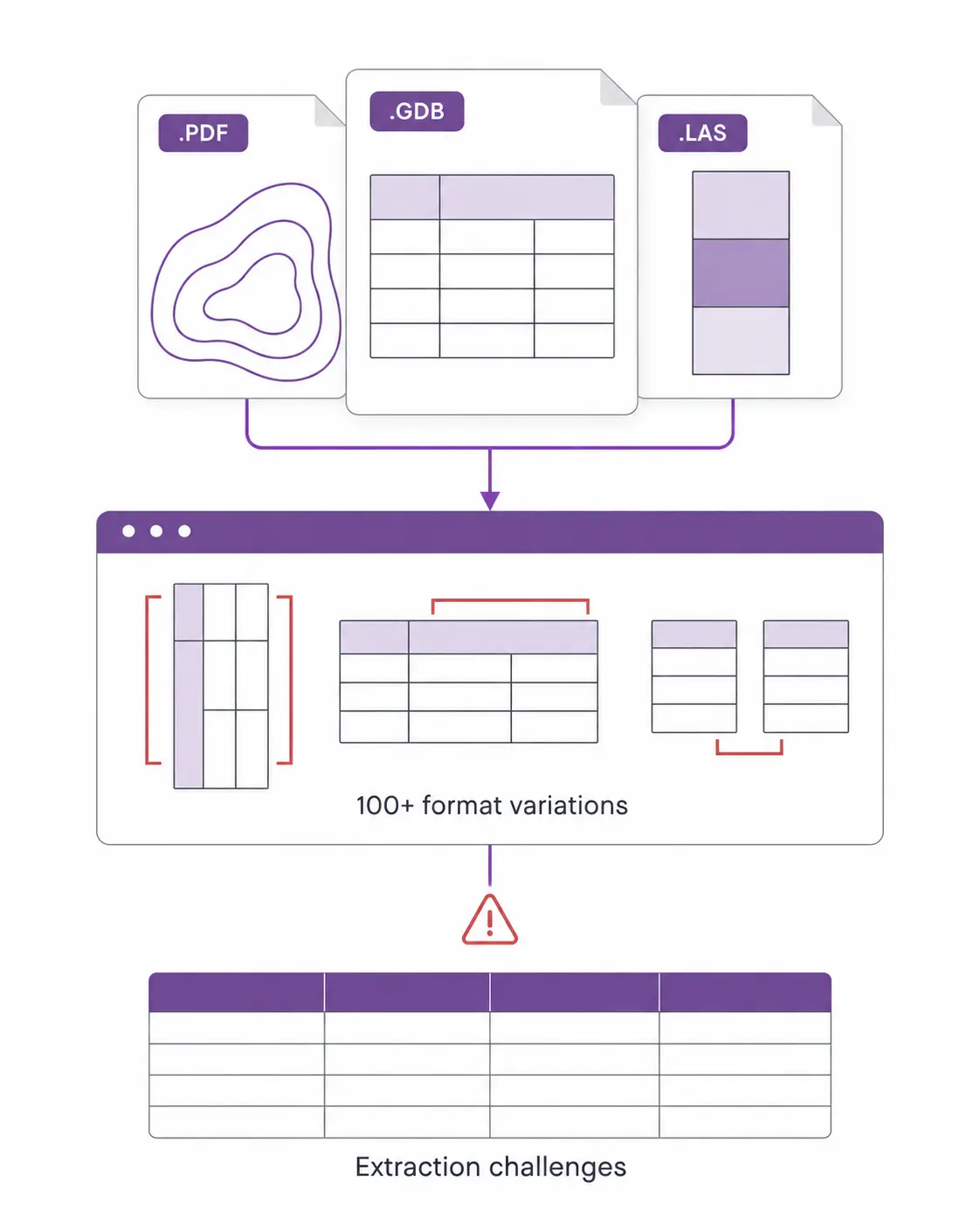
- Structurally inconsistent, with 100+ variations across files
- Full of issues like rotated tables, merged headers, split columns, paragraph-embedded data, and missing separators
- Embedded with annotations, OCR scan errors, and handwritten logs from pre-digital records
- Often in geoscience-native formats (e.g., .gdb, .las) that necessitate use of specialized tools such as Python libraries like lasio, GDAL, and Esri’s proprietary utilities like Geosoft Viewer and GPS Utility as well as OpenFileGDB for parsing. These formats also required custom Python scripts and LLM-based processing (e.g., Llama 3.2) to ensure structured extraction and usability at scale
Objectives
The client envisioned a system that would:
- Unlock publicly held historical geological data for predictive modelling
- Build a modular platform for scalable exploration intelligence
- Ensure data security through LAN-based deployments where required
They engaged Empower Solutions to:
- Lead the technical design and engineering of the platform
- Solve the data extraction and structuring challenge at scale
- Collaborate with internal geoscientists to ensure geological accuracy
Impact
Data Processing & Extraction
- Files Scanned: 2,35,117
- Files Classified (Relevant): 1,12,060
- Files Successfully Extracted: 33,673
- Structured Records Generated & Stored in DB: 32,289,483
Efficiency & Performance
- Manual Effort Reduced: Estimated at 50–60% compared to previous semi-manual workflows, based on current phase performance
- Average Processing Throughput: 60,000–75,000 files per quarter
Strategic Outcomes (Ongoing)
- Exploration Enablement: Extracted data is now feeding uranium prospectivity models
- Security Flexibility: Platform is usable across air-gapped and open environments
- Multi-Site Expansion: Client is preparing for rollout across additional exploration zones in future
- SaaS Commercialization: Architecture designed to evolve into a global platform for mining intelligence
What We Built
Empower Solutions led the development of a multi-layer AI and engineering data extraction platform, built for adaptability, accuracy, and large-scale deployment. This phase focused on extraction, normalization, and infrastructure readiness.
Scanned and catalogued 2.35M+ files
Identified 1.12M relevant for extraction using hybrid logic (rule-based + LLM classification)
Transitioned from GPT-4 to open-source Llama 3.2, deployed via AWS Bedrock
Used prompt engineering to adapt logic for each format without retraining
Built a modular prompt layer, allowing non-engineers including geologists to onboard new file types via a UI-based prompt configuration layer (future development)
Automatically detected and tagged the most critical geological attributes – Hole IDs, sample intervals, depth ranges, and rock types, which are foundational for any uranium exploration analysis. These were often buried in complex paragraph-style data, scattered across multi-format files, handwritten annotations, or non-standard layouts. Empower Solutions’s AI pipeline was purpose-built to intelligently locate, extract, and tag these scattered values across millions of files without requiring manual pre-labelling.
Once tagged, these standardized attributes enabled much faster ingestion into databases and analytics tools. Structured metadata made it possible to instantly query across millions of records by drill hole, depth, location, or sample type, accelerating downstream exploration workflows and powering spatial and statistical analysis models.
The client’s in-house geologists and geoscientists were deeply embedded throughout development. Their insights helped:
Validate field-level accuracy of extractions
Refine metadata schemas for future modelling
Review extraction logs and guide QA tuning
Architecture & Deployment
- Cloud-native SaaS (AWS-based) for scalability
- Secure LAN deployment for high-security environments
- Both environments are under joint testing and refinement with the client, with feature parity being actively validated
Conclusion
This project captures the in-progress success of a critical transformation project: converting six decades of unstructured geological archives into real-time exploration intelligence. Empower Solutions delivered more than automation—we enabled a foundation for AI-first exploration at scale.